How to calm down after an argument (when you're still winning it in your head)
The row is over, but you're still arguing in the shower. What actually helps your body come down first, and why it feels so silly.
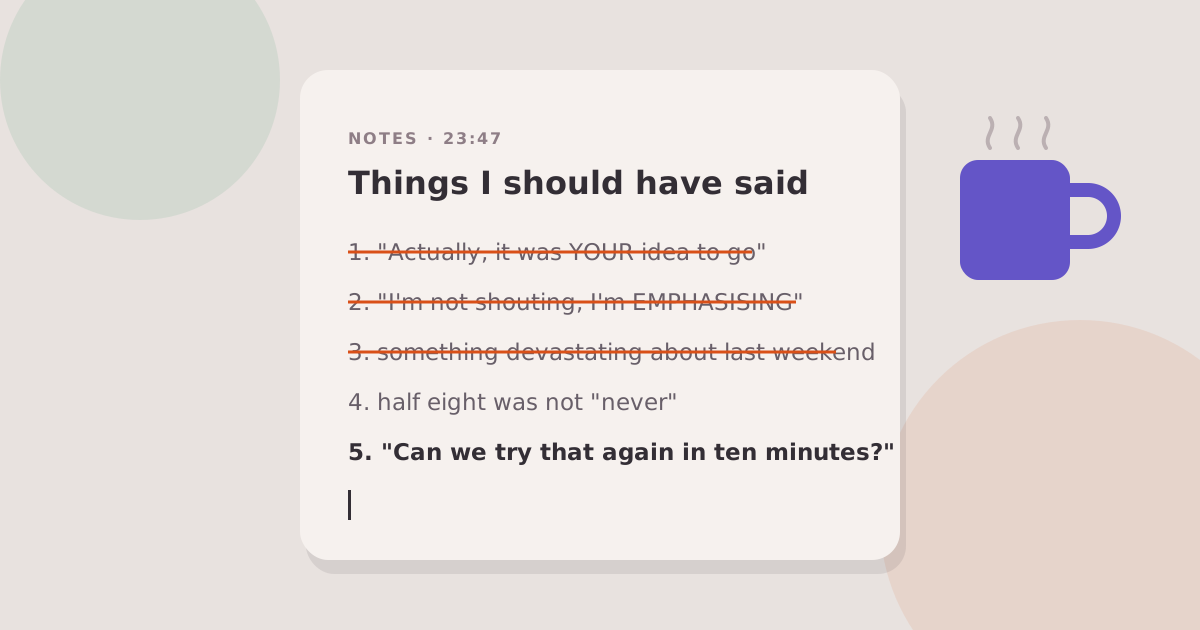
You know the bit after the argument? The door has shut, the call has ended, and you’re standing in the kitchen holding a mug you forgot you’d picked up.
And you’re still going. You’ve come up with the perfect comeback (about forty seconds too late, obviously). You’ve replayed the thing they said about last weekend six times, and in every replay you’re calmer and wittier than you were in real life.
Your heart, meanwhile, is behaving as if there’s a bear in the hallway.
I want to make a slightly annoying case here: don’t try to think your way out of this yet. Sort your body out first. The thinking goes much better afterwards.
Why you can’t just “calm down”
Telling yourself to calm down after a row works about as well as someone else telling you to calm down. Which is to say, it makes things worse and you’d quite like to throw the mug.
The reason is fairly unglamorous. Your body has gone into fight mode. Pulse up, jaw tight, shoulders somewhere near your ears. All of that happened in seconds, and it doesn’t switch off just because the other person left the room. While it’s running, your brain keeps serving up the same five seconds of the argument like a highlights reel nobody asked for.
This is where dialectical behaviour therapy (DBT) is genuinely useful. DBT was developed by the psychologist Marsha Linehan for people whose emotions run very hot, and one of its most practical ideas is a set of skills for exactly this moment, when you’re too wound up for clever thinking. The skills are called TIPP, which stands for temperature, intense exercise, paced breathing and paired muscle relaxation. None of them asks you to reason with yourself. They just work on the body directly.
They also all look a bit daft. Stick with me.
Put your face in cold water
Yes, really. Fill the sink with cold water, or grab an ice pack wrapped in a tea towel, or a bag of frozen peas if that’s what you’ve got. Hold it over your eyes and cheeks for about thirty seconds while you hold your breath.
This sets off what’s called the diving response, the same reflex that kicks in when your face hits cold water. Researchers who study it describe a drop in heart rate as the normal reaction to cold water on the face. In other words, you’re borrowing a bit of ancient wiring to tell your heart to ease off.
You don’t need to plunge your whole head into a bucket like you’re bobbing for apples. Cold on the forehead and around the eyes is the important part. (If you’ve got a heart condition, check with your doctor before you make a habit of this one.)
Burn off the adrenaline
An argument gets you ready to do something. Sitting rigid on the sofa doesn’t use any of that up, so it just sloshes around.
So give it somewhere to go. Run on the spot for a minute. Do star jumps. Charge up and down the stairs a few times. Go hard enough that you’re a bit out of breath.
You will feel ridiculous. That’s fine. Nobody’s watching, and doing star jumps in your hallway is a much better use of the energy than drafting a furious text with your thumbs.
Slow your breathing right down
Now breathe in for four and out for six. Keep it going for a minute or two.
People get oddly precious about breathing ratios, so here’s some good news. One recent study compared breathing out for the same time as breathing in with breathing out for twice as long, both at about six breaths a minute, and found no real difference between them. What seems to matter most is that you go slower than you were. Four in, six out is just an easy pattern to count. If your counts wobble, nothing is ruined.
Squeeze, then let go
Last one. Make fists and squeeze hard for five seconds, then let your hands fall open. Screw your whole face up like you’ve bitten a lemon, then let it go slack. Hunch your shoulders up to your ears, hold, and drop them.
The letting go is the point. You’ll often only notice how tense you were when you stop. Plenty of us carry the whole argument in our shoulders for the rest of the evening without realising.
If remembering four steps in the right order sounds like a lot when you’re furious (it is), that’s exactly why we built Take4. It walks you through all four, a minute each, so you only have to follow along. It’s about four minutes, and you can do it in the bathroom with the door shut.
Then go back to the argument
This is the bit people expect me to skip: once your body has come down, the argument is still there. Calming down doesn’t make you wrong, and it doesn’t make the issue go away. It just means you can think about it without your pulse doing all the talking.
One more DBT idea is handy here. It’s called checking the facts. Grab your phone and write down what actually happened, as flatly as a police report: “I said I’d be home by seven. I got in at half eight. They said I never think about anyone else.”
Then, underneath, write what you made it mean. “They think I’m selfish. They always do this. This whole relationship is…” and so on.
The first list is nearly always shorter than the second. That gap is useful. The half eight is worth talking about. The “never” is usually the argument talking.
When you’re ready, keep it simple: “Can we have another go at that? I was getting louder than I meant to.” Or, if it needs a proper conversation, agree on when. Either way you’ll go back with something better than the speech you’ve been rehearsing at the kettle, which, let’s face it, was never going to land the way it did in your head.
Where this comes from
- Malinowski KS et al. (2023). Resting heart rate affects heart response to cold-water face immersion associated with apnea. Biology, 12(6), 869.
- Meehan ZM, Shaffer F. (2024). Do longer exhalations increase HRV during slow-paced breathing? Applied Psychophysiology and Biofeedback, 49(3), 407–417.